Wednesday, November 20, 2013

Mendelian Genetics (Monohybrid Cross)

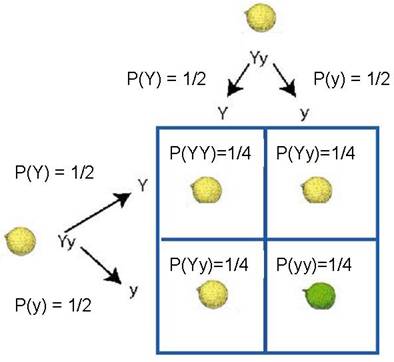
In order to do Mendelian genetics problems, we must understand these two laws.

  • The principle of segregation (First Law): The two members of a gene pair (alleles) segregate (separate) from each other in the formation of gametes. Half the gametes carry one allele, and the other half carry the other allele.
  • The principle of independent assortment (Second Law): Genes for different traits assort independently of one another in the formation of gametes.
In a monohybrid cross, we analyze organisms with one trait. Let's take the color of fur on a type of bear for example. The black fur is the dominant trait, and the brown fur is the recessive trait. B and b are alleles respectively for each trait. We can have combinations of different types of bears (homozygous dominant, heterozygous dominant, and homozygous recessive)--(BB, Bb, bb). When two bears cross, they form gametes by assorting the alleles independently according to the Mendelian laws.


Operon System


An operon system controls the rate of protein synthesis. There are two types of operons. The first type is called repressible operon, in which protein is being synthesized. In order to stop the process, an amino acid called tryptophan has to be created in order to transform the inactive repressor to active repressor. In this process, RNA polymerase reads DNA to create mRNA. So polypeptides are created for tryptophan. Then tryptophan can attach to protein that blocks the RNA polymerase.


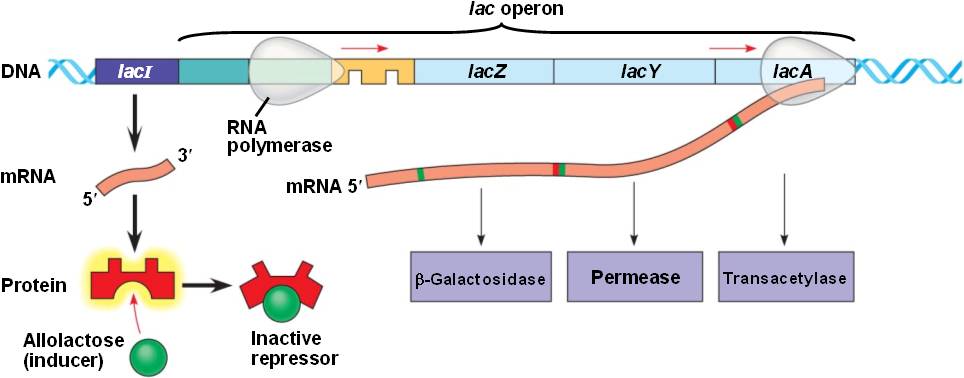
Another type of operon is inducible operon. This type of system is not producing protein at first. Allolactose is served as an inducer to inactivate the repressor. In the Arabinose operon system, which is an inducible one, Arabinose is added to start the protein synthesis. RNA polymerase is able to come in and arabinase is produced to digest sugar. When there is too much enzyme, the system will shut off and the process would repeat over and over.

Protein Synthesis


DNA is able to create protein through protein synthesis. Even though DNA contains information that encodes protein, DNA molecules cannot go out the nuclear membrane because their shape is too large. Therefore, DNA is transcribed into mRNA. First, the DNA strands are replicated. RNA polymerase reads DNA from 3’ to 5’ and synthesizes a strand of messenger RNA in the 5’ to 3’ direction. In mRNA, every 3 RNA bases form a codon. In the processing of RNA, introns, which are noncoding parts of DNA, are cut out via splicesomes. Only exons are left. A G-cap (Guanine), is put on the mRNA to protect the message. And a poly A tail with many A nucleotides is added as well. In translation, mRNA is first decoded to produce polypeptides that make up the amino acids. The transfer RNA carries amino acids to the ribosome where proteins are processed. mRNA and tRNA make codons and anticodons match with each other in the ribosome. There are three sites in the ribosome. A site accepts codons and anticodons; P site binds the peptides; and E site makes the protein exit. Start codon is known as Met (AUG).

DNA Replication


DNA replication is a process in which two identical copies are created from one original DNA molecule. This process occurs in all living organisms and provides the basis for inheritance. It is a semiconservative process, meaning that each original serves as a template for the production of a complementary strand. 

The origin of replication is called promoter. The replication fork is created by helicase, which breaks the strands into two parts by breaking hydrogen bonds between nucleobases. There are two parts of each strand, the leading strand and the lagging strand. Then, RNA Primase comes in to create RNA that has a polar 3’ end. Its job is to help DNA polymerase read since DNA polymerase is polar. DNA polymerase III creates new nucleotides for the new strand of DNA. The bond in between the bases is a phosphodiester bond. It is important to distinguish that DNA is read from 3’ to 5’, but its synthesized from 5’ to 3’. Afterwards, DNA Polymerase I comes to replace RNA with DNA. However, the bond between these replaced DNA nucleotides is still incomplete. These nucleotides are known as Okazaki fragments. Finally, ligase glues DNA nucleotides together by phosphodiester bonds. This is the process of DNA Replication.

Monday, November 4, 2013

Homework 11/5

This flower has different colors including white, dark purple, and light purple. According to the book Survival of the Sickest, one possible explanation for this phenomenon is that the flower has undergone mutations that change its color to protect itself. The colors can help the flower to camouflage among plants and distribute its offspring.


The superfluous fingers are a result of the mirror-image duplication. The genes in the zone of polarizing activity were removed to another tissue so that these extra fingers were instructed to be formed. These genes capable of making different body segments are called sonic hedgehogs.

Wednesday, October 30, 2013

Your Inner Fish Chapter 3

Scientists have been wondering that what kind of cells in our body is responsible for making our body characteristics look different. The researchers started by observing chicken eggs and the embryos. They moved around tissues to see if different changes occur in the characteristics.

As a result, scientists discovered the mirror-image duplication. They removed a tissue to the other side of the limb of the chicken, and the fingers still grow normally. This explains that certain cells are capable of instructing others to form the structure of the body. This patch of tissue is called the zone of polarizing activity. (ZPA)

Later, scientists found that the gene capable of making body segment different from another is also present in fly. They named it hedgehog. Soon, it is uncovered that every limbed animal has the Sonic Hedgehog gene.

A scientists chose to do experiments on shark embryos since they are the first animals that have fins with skeletons. They are very distantly related to human beings. However, it is very difficult to obtain shark embryos; therefore, skates embryos are used instead. After experiments on such embryos, it is found that Sonic Hedgehog in these embryos were turned on and turned on in the patch of tissue at the back end of the fin, which matches the chicken and fly embryos. Through vitamin A treatment, the mirror-image fin is discovered in the embryos as well. Therefore, scientists found the gene that is responsible for making different segments in our limbs.

Monday, October 28, 2013

Survival of the Sickest Chapter 6

Our DNA is composed of about 3 billion nucleotides. All the genes in DNA are organized in 23 pairs of chromosomes: 50% from the father, 50% from the mother. The chromosomes contain information that code our body's characteristics. The dominant traits are always preferred in the case of one dominant trait and one recessive trait.

At first, scientists thought that only accidental mutations can cause genetic changes. For example, throughout the history, there were pandemics associated with the peaks of sunspot. The reason was that there was an antigenic shift/drift in our genes and it makes our bodies vulnerable to environment changes. Thus, we don't have the antibodies to fight with diseases. 

However, Barbara McClintock discovered that genetic changes can happen in a non-accidental way. McClintock observed genes in corns that sometimes the whole sequence of DNA moves from one place to another. And this phenomenon, she believed, is triggered by outside threats to the survival of the corn. Therefore, she called the genes in corns that make this change happen "jumping genes".

John Cairns also tested the mutation in genes by observing the genes of bacteria E. coli, which is a bacteria that digests the food. When Cairns fed nothing but lactose to the bacteria, the bacteria went through mutations that got rid of the lactose intolerance. He concluded that genes can choose to mutate. Other scientists propose the theory of "hypermutation", in which the genes are adapted to the environment due to massive increase in the mutation rate.

Originally, scientists found that only 3% of the genes in DNA are actually coding genes. They entitle the rest as "junk genes" at first. However, later they found that a large portion of noncoding genes are made of "jumping genes". Many strands of DNA contain viruses and bacteria that associated with human bodies a long time ago.

The Weissmann barrier distinguishes cells into germ cells and somatic cells. Changes in somatic cells can only happen in current carrier and cannot be passed on to the offspring.