This flower has different colors including white, dark purple, and light purple. According to the book Survival of the Sickest, one possible explanation for this phenomenon is that the flower has undergone mutations that change its color to protect itself. The colors can help the flower to camouflage among plants and distribute its offspring.
The superfluous fingers are a result of the mirror-image duplication. The genes in the zone of polarizing activity were removed to another tissue so that these extra fingers were instructed to be formed. These genes capable of making different body segments are called sonic hedgehogs.
Monday, November 4, 2013
Wednesday, October 30, 2013
Your Inner Fish Chapter 3
Scientists have been wondering that what kind of cells in our body is responsible for making our body characteristics look different. The researchers started by observing chicken eggs and the embryos. They moved around tissues to see if different changes occur in the characteristics.
As a result, scientists discovered the mirror-image duplication. They removed a tissue to the other side of the limb of the chicken, and the fingers still grow normally. This explains that certain cells are capable of instructing others to form the structure of the body. This patch of tissue is called the zone of polarizing activity. (ZPA)
Later, scientists found that the gene capable of making body segment different from another is also present in fly. They named it hedgehog. Soon, it is uncovered that every limbed animal has the Sonic Hedgehog gene.
A scientists chose to do experiments on shark embryos since they are the first animals that have fins with skeletons. They are very distantly related to human beings. However, it is very difficult to obtain shark embryos; therefore, skates embryos are used instead. After experiments on such embryos, it is found that Sonic Hedgehog in these embryos were turned on and turned on in the patch of tissue at the back end of the fin, which matches the chicken and fly embryos. Through vitamin A treatment, the mirror-image fin is discovered in the embryos as well. Therefore, scientists found the gene that is responsible for making different segments in our limbs.
Monday, October 28, 2013
Survival of the Sickest Chapter 6
Our DNA is composed of about 3 billion nucleotides. All the genes in DNA are organized in 23 pairs of chromosomes: 50% from the father, 50% from the mother. The chromosomes contain information that code our body's characteristics. The dominant traits are always preferred in the case of one dominant trait and one recessive trait.
At first, scientists thought that only accidental mutations can cause genetic changes. For example, throughout the history, there were pandemics associated with the peaks of sunspot. The reason was that there was an antigenic shift/drift in our genes and it makes our bodies vulnerable to environment changes. Thus, we don't have the antibodies to fight with diseases.
However, Barbara McClintock discovered that genetic changes can happen in a non-accidental way. McClintock observed genes in corns that sometimes the whole sequence of DNA moves from one place to another. And this phenomenon, she believed, is triggered by outside threats to the survival of the corn. Therefore, she called the genes in corns that make this change happen "jumping genes".
John Cairns also tested the mutation in genes by observing the genes of bacteria E. coli, which is a bacteria that digests the food. When Cairns fed nothing but lactose to the bacteria, the bacteria went through mutations that got rid of the lactose intolerance. He concluded that genes can choose to mutate. Other scientists propose the theory of "hypermutation", in which the genes are adapted to the environment due to massive increase in the mutation rate.
Originally, scientists found that only 3% of the genes in DNA are actually coding genes. They entitle the rest as "junk genes" at first. However, later they found that a large portion of noncoding genes are made of "jumping genes". Many strands of DNA contain viruses and bacteria that associated with human bodies a long time ago.
The Weissmann barrier distinguishes cells into germ cells and somatic cells. Changes in somatic cells can only happen in current carrier and cannot be passed on to the offspring.
Thursday, October 24, 2013
Response to DNA
1. Mendel designed the experiment
between different types of peas. By breeding different types of peas together,
Mendel compared the offspring of these peas and found that they have traits
resembling to one of their two parents. As there are more crosses, both types
of traits appear in undiluted form in the future offspring. This experiment
shapes the perception of heritable variant from being blendable and ephemeral
to long lasting and heritable.
2.
James Watson and Francis Crick
discovered the double-helix structure of DNA.
3.
Mutations
·
Substitution of a single letter
·
Deletion of a block of letters
·
Duplication or insertion of new
letters
·
Inversion and translocation of
the letters present
4.
Evo-devo is the study of the
effects of changes in important developmental genes and the role they play in
evolution
5.
An individual that comes from a
group that stops drinking milk after infancy is not able to tolerate lactose
through adulthood, while the other group of people who drink milk through
adulthood have lactase enzyme to digest lactose in milk.
Tuesday, October 22, 2013
Response to Founder Mutation
Response to Founder Mutations
According to Charles Darwin’s theory of
evolution, all organisms can be traced to a common ancestor and nature selects
the stronger ones to survive. However, nowadays millions of people are still
struggling with diseases that are caused by gene mutations. If natural
selection has taken place, why are there people with diseases still live and
have offspring? The article “Founder Mutations” brings up several interesting
points about this topic. First, the recessive genes are beneficial to the
carriers in some cases. For example, sickle cell mutation arose repeated in
regions in Africa and Middle East inflicted with malaria. A copy of sickle cell
gene can help carriers survive malaria. Another example is that the patients of
hemochromatosis have benefits as well. They can be protected from
iron-deficiency anemia because the protein encoded in the gene helps the
patients absorb iron more effectively. However, what is the origin of these
gene mutations? In fact, the gene mutations come from a mutation founder. This
founder passes this gene on to his offspring. Archaeological and geneticist’s
evidence shows that certain diseases come from a specific area, confirming that
human beings were able to migrate from places. In the video “The Journey of
Man”, Spencer Wells visited the African tribe that was supposed to be oldest
human tribe on the Earth. The tribesmen’s appearances are constituted with the
characteristics from people all around the world. Wells also mentions the
theory of migration started from Africa. Therefore, founder mutations can be
found in numerous places around the world.
Thursday, October 17, 2013
Brine Shirmp Lab Blog
Evolution—Brine
Shrimp Lab
Question: In what environment can brine
shrimp eggs be hatched more easily and quickly?
Hypothesis: Brine shrimps can be hatched in
solutions with high concentration of salt.
Procedure
1.
Prepare 5 different solutions
with 0%, 0.5%, 1.0%, 1.5%, and 2% of salt concentrations
2.
Put roughly 30 eggs on the
plate and count the number of eggs under the microscope
3.
Put the plates into solutions
4.
Count the number of eggs and
live shrimps after 24 hours
5.
Take out the live shrimps
6.
Count the number of eggs and
live shrimps again after 48 hours
Observation:
In 0% solution, no eggs were hatched. The
0.5% solution has the highest hatching viability and the number goes down after
0.5% solution until 1.5% solution. The 2% solution has a hatching ability of
40%.
Conclusion
Therefore, it can be concluded that brine
shrimps are able to adapt to any type of water environment with salt. This
explains the instability of brine shrimp population at Utah. When the water
evaporates, the salinity becomes higher in the water, and therefore the eggs
were preserved in the water. When there is more rain, the concentration in
water goes down and eggs can be hatched.
This experiment shows the organisms’
ability to adapt to the living environment and their methods to survive.
Wednesday, October 16, 2013
Hardy Weinberg Law Blog
Hardy-Weinberg
Law
In the class, we learned the theory
proposed by Hardy and Weinberg. The law is based on such conditions.
1.
The breeding population is
large
2.
Mating is random
3.
There is no mutation of the
alleles
4.
No differential migration
occurs
5.
There is no selection.
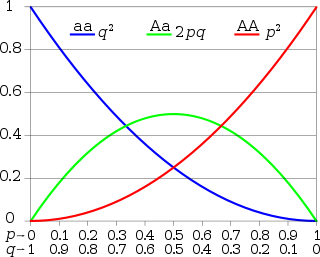
There are two types of genes in the
population. The organisms either have homozygous, heterozygous, and recessive
genotypes.
P is the value of dominant allele frequency
and q is the value of recessive allele frequency.
P+q=1 all the time
The value of p^2 indicates the possibility
of homozygous genotypes in the population. The value of 2pq indicates the
possibility of heterozygous genotypes in the population. The value of q^2
indicates the possibility of recessive genotypes.
Subscribe to:
Posts (Atom)