Monday, April 14, 2014

Animal Behavior Lab

Abstract
In this lab, there were two major purposes of investigation. The first factor of studying isopods’ behavior was their preference on the humidity of their living environment. Data collected from experiment show that isopods are evenly distributed on preference of wet or dry environment. The second factor of studying isopods’ behavior was their preference on the acidity of their living environment. By presenting two different environments with a control, the bugs were free to choose which environment to go to without light. Data show that they prefer slightly basic environment to the acidic one.

Background
Behavior—Behavior is everything an animal does and how it does everything.
Proximate Question—Explanation of an animal's behavior based on trigger stimuli and internal mechanisms (What outside stimuli causes bird to sing?)
Ultimate Question— Explanation of an animal's behavior based on evolution (Why can bird sing?)
Fixed-action patterns—Stereotypical behaviors that are triggered by specific stimuli (Ducks swim once they are in water)
Imprinting—The recognition of some object as “mother” when it’s seen during a critical time period shortly after birth. (Proximate Cause: When the geese were very young, they saw their mothers moving away and calling. Ultimate Cause: Geese have a better chance of surviving when they learn skills from their mother.)
Taxis—A specific, directed motion in response to a stimulus (Photosynthetic protest, Euglena, moves toward the light source)
Kinesis—A random, undirected motion in response to a stimulus (Cockroaches bolt in random directions if a light shines on them)
Classical Conditioning—A kind of learning that occurs when a conditioned stimulus is paired with an unconditioned stimulus
Operant Conditioning—A type of learning in which an individual's behavior is modified by its antecedents and consequences

Hypothesis
If the pH value of the environment is more basic, the isopods would prefer this type of environment to more acidic ones. The independent variable is pH value of the environment and the dependent variable is the number of isopods in this type of environment.

Procedure
1.              Collect 10 isopods from the wild
2.              Place isopods in a Petri dish with a paintbrush and observe them for 10 minutes. Record observations that are characteristic to the bugs.
3.              Place a wet filter paper in one chamber and a dry one in the other.
4.              Put the isopods in and cover the chambers
5.              Start the stopwatch and record the number of isopods in each chamber every 30 seconds
6.              After 3 minutes, replace the wet filter paper with one with vinegar
7.              Repeat procedure 4-5
8.              After 3 minutes, replace the vinegar filter paper with one with ammonia
9.              Repeat procedure 4-5

Data Table
Time (Minutes)
Number in Chamber One
Number in Chamber Two

Wet
Dry
0


0.5
6
4
1.0
5
5
1.5
2
8
2.0
4
6
2.5
4
6
3.0
4
6
3.5
3
7
4.0
3
7
4.5
3
7
5.0
3
7

Acid
Control
0.0


0.5
1
9
1.0
0
10
1.5
0
10
2.0
0
10
2.5
0
10
3.0
0
10
3.5
0
10


Base
Control
0.0


0.5
1
9
1.0
3
7
1.5
4
6
2.0
4
6
2.5
5
5
3.0
6
4


X-Axis: pH value
Y-Axis: The number of isopods in the chamber with vinegar/ammonia filter


Conclusion

According to the data table, isopods’ preference on the humidity of environment lies more with dry environment. However, the number of isopods in each chamber is 3 and 7. Therefore, we cannot draw any definitive conclusion because this result may happen from chance. On the other hand, extreme data of the number of isopods on a vinegar filter paper indicate that isopods do not like extremely acidic environment with pH value less than 2. Looking at the data for basic environment, we can conclude that slightly basic environment does not cause a major effect on isopods’ preference. The number of them is more evenly distributed between the ammonia filter paper and the control as 5 to 5 or 6 to 4. Therefore, from the collected data, we conclude that isopods slightly prefer dry environment, cannot tolerate extremely acidic environment, and like slightly basic environment.

Friday, March 7, 2014

Immune System Quiz

1

.     Provides an immediate nonspecific immune response
Nonspecific immune system provides immediate defense against infection. However, it does not confer long-lasting or protective immunity to the host. Inflammation is one of the first responses of the immune system to infection or irritation. Inflammation is stimulated by chemical factors released by injured cells and serves to establish a physical barrier against the spread of infection, and to promote healing of any damaged tissue following the clearance of pathogens. The cells involved in inflammation include macrophages, dendritic cells, histiocytes, Kupffer cells, and mastocytes. Phagocytes are able to kill viruses by eating antigens and sending them to lysosomes, where enzymes and acids can digest the particle or organism.

Macrophage has receptor on its surface and then the receptor triggers the macrophage to engulf the antigen. Dendritic cells are mainly in the skin. The skin is usually the most common area to be in touch with bacteria or virus. Some of them remain at the skin because dendritic cells prevent them from being permeated.


2.     Activates T and B cells in response to an infection
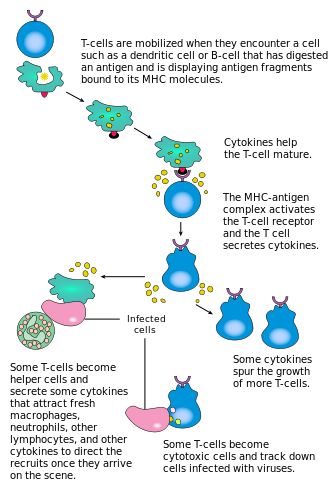
The B lymphocytes are made in the bone marrows. They are responsible for the humoral response. A B cell is triggered when a matching antigen attaches to it. The B cell engulfs the antigen and digests it. After digestion, the B cell displays antigen fragments bound to its unique MHC (Major histocompatibility complex)
molecules. The combination of antigen and MHC brings in the help of a matching T cell with the presence of a protein CD4+. Cytokines produced by the T cell help the B cell to reproduce and grow into antibody. The antibodies are then released into the blood and match onto antigens.
T cells are released from the thymus. They are mobilized to help B cells that have already digested the antigen with the MHC combination. T cells are matured by the cytokines. Some T cells become helper cells that secrete cytokines to attract macrophages and other lymphocytes. Some T cells become cytotoxic cells and track down infected cells. Some cytokines produce more T cells.


3.     Responds to a later exposure to the same infectious agent
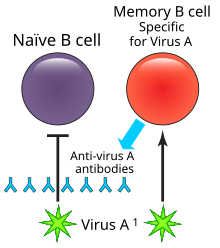
When the antigen enters the body, the responding naive B cells (ones that have never been exposed to the antigen) undergo clonal selection to produce a colony of cells that are specific for the antigen. Most of the cloned B cells differentiate into the plasma cells. The rest become memory B cells, which will survive for an average of ten years. The antibody molecules on a clone have unique paratope (the sequence of amino acids that binds to the epitope on an antigen.) Over many years, when the same antigen invades, the paratope, which match the antigen, will proliferate and have a better affinity for the antigen, thus killing the antigen faster than the first time.
The memory T cells work in similar mechanism. Memory T cells are also known as potentially cancer-fighting cells. They can recognize foreign invaders and cancer cells. Their function follows the principle of vaccination, which helps phagocytes to kill the antigen faster than the first time the person is vaccinated.


4.     Distinguishes self from nonself

Almost all of our body molecules are distinctive to our body. Therefore, they identify themselves as the master of the body. When a foreign invader enters our body, our antibodies will recognize them as hostile and will attack them. Usually, the method for body cells to distinguish from each other is by the molecule’s epitope. Epitope means the characteristic shape of a molecule. Most antigens, even the simplest microbes, carry several different kinds of epitopes on their surface; some may carry several hundred. If the marker on the antigen matches with the site on an antibody molecule, the antibody will bind to the antigen and activate other phagocytes to digest the antigen. In abnormal situations, the immune system can wrongly identify self as nonself and start a unnecessary immune attack. In some people, an apparently harmless substance such as ragweed pollen or cat hair can provoke the immune system to set off the inappropriate and harmful response known as allergy; in these cases the antigens are known as allergens.

Sunday, March 2, 2014

Cellular Respiration

Cellular respiration takes place for cells to use energy from food to function by producing ATP (Adenosine Triphosphate). The process can be divided into three parts: Glycolysis, citric acid cycle, and electron transport chain.
 
Glycolysis:
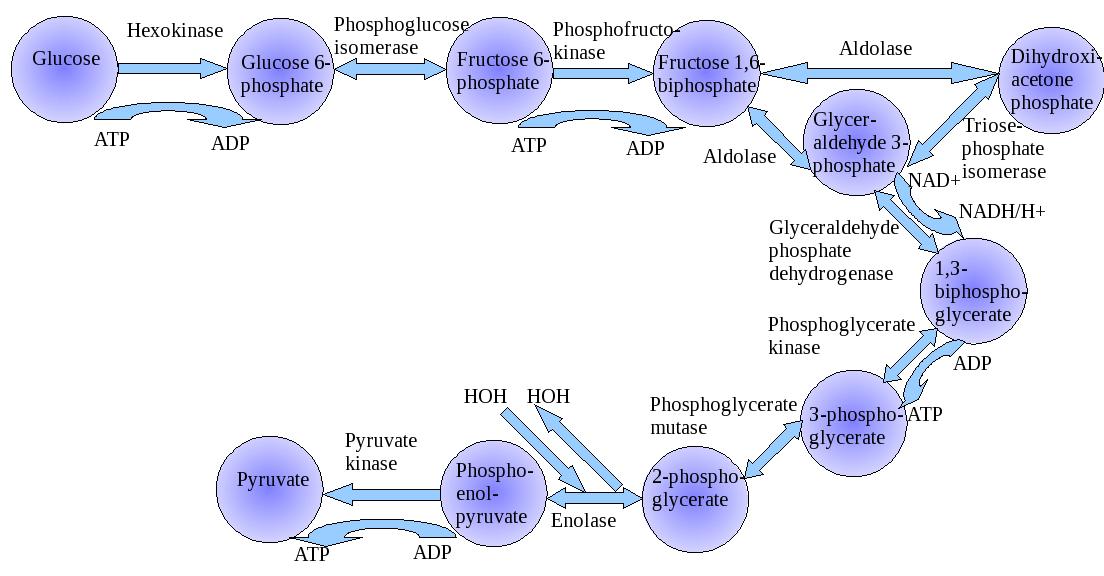
Glycolysis takes place in the cytoplasm. When glucose enters glycolysis, it is divided into two 3-carbon molecules called pyruvates. In this process, extra protons and electrons are given off. When the NAD+ molecule combines with two protons, it is reduced to NADH, which carries electron with high energy. Also, during this process, 2 ATP molecules are used and 4 are produced, making a total production of 2 ATP molecules.

Glycolysis is unique because all organisms are able to use this process. This is the only step in cellular respiration that does not require the presence of oxygen to take place.


Citric Acid Cycle:
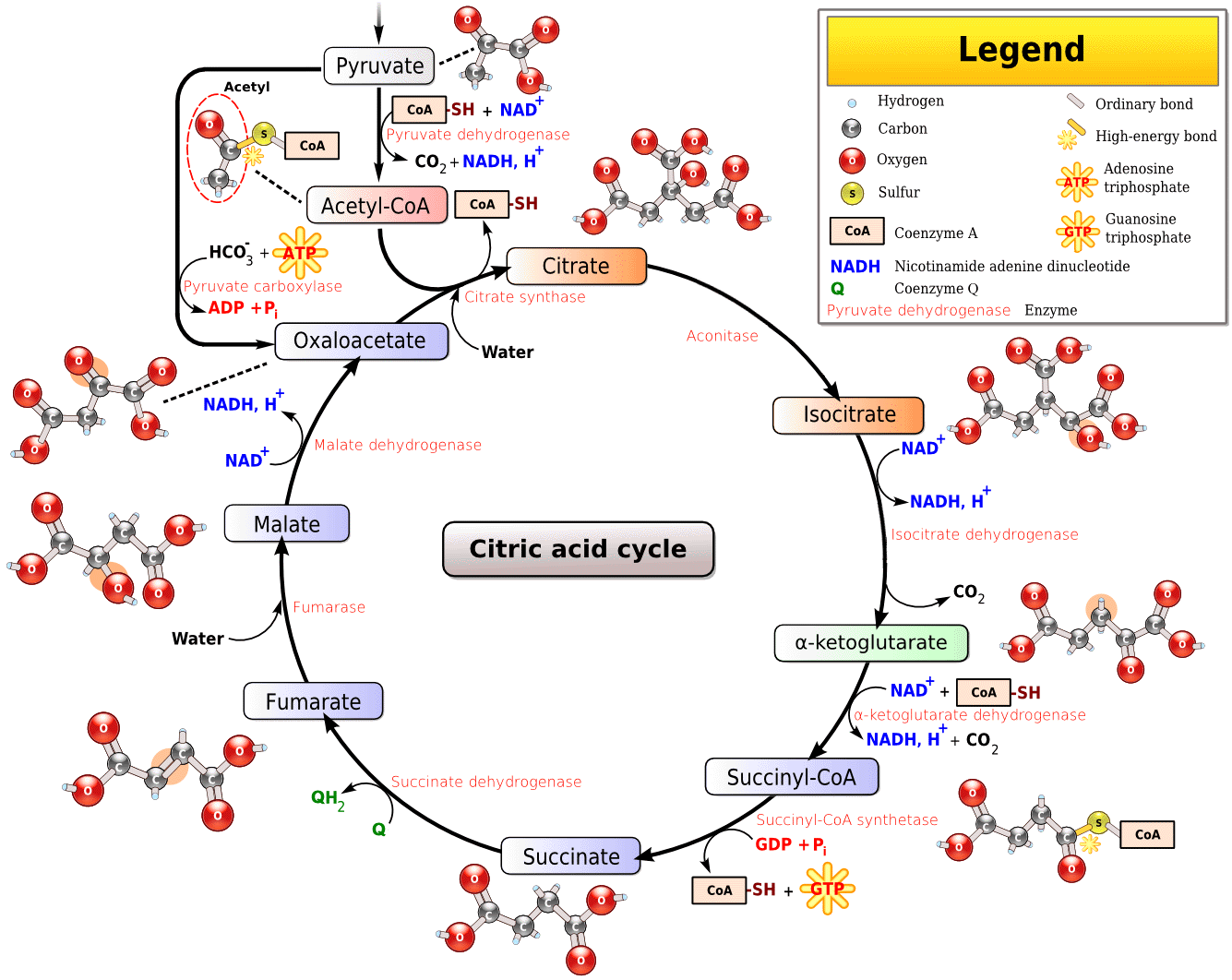
In between the citric acid cycle and glycolysis, each pyruvate molecule undergoes a process, in which the end carbon of each pyruvate is removed along with oxygen to produce carbon dioxide. Then, the 2-carbon molecule binds to a coenzyme A to form acetyl CoA.

The molecule acetyl CoA enters the cycle with water and binds to another molecule to form a citric acid. At the same time, the hydrogen of the sulfhydryl group on CoA is replaced. The remainder of the sulfhydryl group undergoes eight steps in the cycle, giving off carbon dioxide at two points. Also, along the way, NADH, FADH2, two electron carriers are formed. ATP is also produced in this cycle through substrate phosphorylation.


Electron Transport Chain:
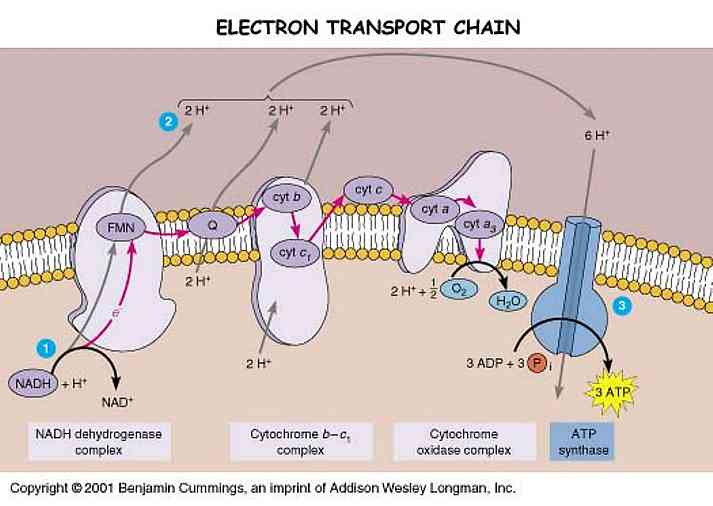
In total, 10 molecules of NADH and 2 molecules FADH2 will enter the electron transport chain. They are oxidized back to NAD+ and FAD again when they lose electron to the chemicals in the transport chain. Then the chemicals pass the electrons off to the next chemical. The final acceptor of the electrons is oxygen, which uses them to form water.


At three specific points of the chain, when the chemicals pass on electrons, they must also release a proton into the intermembrane space. In order to balance the concentration of H+ in the intermembrane space, these protons want to go back into the mitochondrial matrix. An enzyme called ATP synthase lets the protons pass through and forms ATP and water molecules by combining ADP and phosphate group. This method of making ATP is called chemiosmotic synthesis.

Human Digestive System

Functions of all organs in the digestive system

Oral Cavity: the first part of the digestive system, where food enters the body.

Chewing and salivary enzymes in the mouth are the beginning of the digestive process (breaking down the food).

Salivary Glands: glands located in the mouth that produce saliva. Saliva contains enzymes that break down carbohydrates (starch) into smaller molecules.

Epiglottis: the flap at the back of the tongue that keeps chewed food from going down the windpipe to the lungs. When you swallow, the epiglottis automatically closes. When you breathe, the epiglottis opens so that air can go in and out of the windpipe.

Esophagus: the long tube between the mouth and the stomach. It uses rhythmic muscle movements (called peristalsis) to force food from the throat into the stomach.

Stomach: a sack-like, muscular organ that is attached to the esophagus. Both chemical and mechanical digestion takes place in the stomach. When food enters the stomach, it is churned in a bath of acids and enzymes.

Small Intestine: After being in the stomach, food enters the duodenum, the first part of the small intestine. It then enters the jejunum and then the ileum (the final part of the small intestine). In the small intestine, bile (produced in the liver and stored in the gall bladder), pancreatic enzymes, and other digestive enzymes produced by the inner wall of the small intestine help in the breakdown of food.

Large Intestine: After passing through the small intestine, food passes into the large intestine. In the large intestine, some of the water and electrolytes (chemicals like sodium) are removed from the food. Many microbes (bacteria like Bacteroides, Lactobacillus acidophilus, Escherichia coli, and Klebsiella) in the large intestine help in the digestion process. The first part of the large intestine is called the cecum (the appendix is connected to the cecum). Food then travels upward in the ascending colon. The food travels across the abdomen in the transverse colon, goes back down the other side of the body in the descending colon, and then through the sigmoid colon.

Liver: a large organ located above and in front of the stomach. It filters toxins from the blood, and makes bile (which breaks down fats) and some blood proteins.

Gall Bladder: a small, sac-like organ located by the duodenum. It stores and releases bile (a digestive chemical which is produced in the liver) into the small intestine.


Pancreas: an enzyme-producing gland located below the stomach and above the intestines. Enzymes from the pancreas help in the digestion of carbohydrates, fats and proteins in the small intestine.

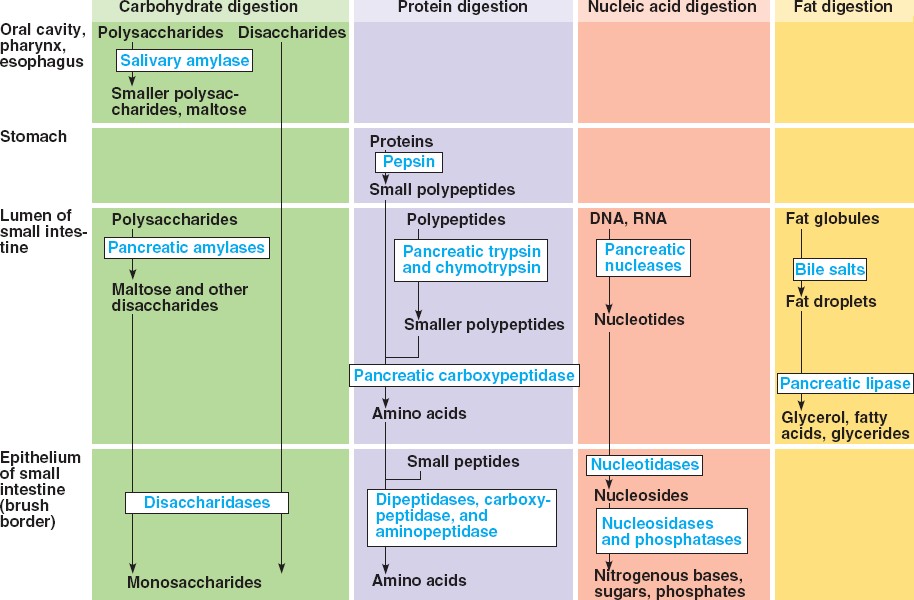
The digestion of macromolecules
Reference: http://www.enchantedlearning.com/subjects/anatomy/digestive/

Enzyme

Enzymes
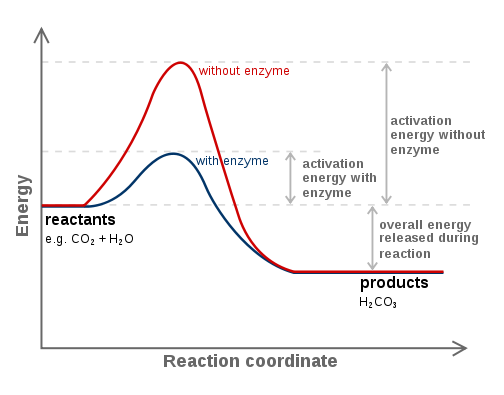
Enzymes are proteins. They are made of amino acids and folded into different shapes. At most of the time, enzymes function as catalysts. They increase the rate of reactions by lowering the activation energy (minimum energy required for a reaction to take place). As a result, products are formed faster and reactions reach their equilibrium state more rapidly.


Reactants that bind to enzymes are called substrates. Substrates usually attach themselves to enzymes at specific regions called active sites of the enzyme. The active sites have precise shapes for substrates. It works like a lock and a key, in which the enzyme is a lock and the substrates are the key. After the reaction, products are released from the active sites as well.


There are two types of enzyme inhibitors. The first type is called competitive inhibitors. This type of inhibitor binds to the active site and blocks the substrate from attaching to the enzyme. The second type is called non-competitive inhibitor. This type of inhibitors binds to a regulatory region and changes the shape of the active site, and thus substrates cannot bind to them.


Some enzymes have positive feedback system. When the detector senses that products are produced, the enzymes process more reactions and produce more products. The negative feedback system is more common. When the detector senses there are excessive products, enzymes lower the rate of reaction.


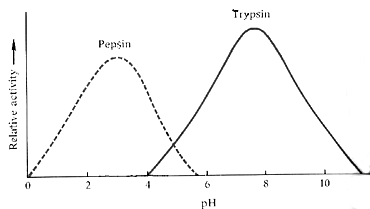
Enzymes also work best in specific environments, where the temperature and pH values suit them best. For example, pepsin digests polypeptides in the stomach where the environment is extremely acidic. The enzymes will change the shape of their active sites when the pH value and temperature is not the best for them.