Monday, January 27, 2014

Cancer

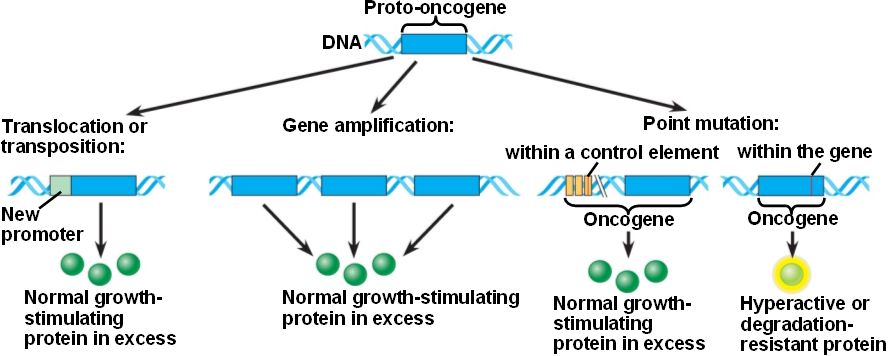
Cancer has always been part of our body. In our DNA, there are genes called proto-oncogenes. If these genes are mutated into oncogenes, they can activate cancer cells to reproduce.


Another cause of cancer is the malfunction of tumor suppressor gene. A tumor suppressor gene is gene that protects a cell from one step on the path to cancer. When these genes mutate, they stop regulating the reproduction of cancer cells.


In order for cancer cells to reproduce, they need a large amount of ATPs. Usually, they absorb and suck those ATPs from other cells so that other cells stop reproducing and the body would slowly die out.


Thursday, January 23, 2014

Question on The Island

In the movie, the cloned human beings have all the features of human beings including memory and emotions. These specific features allow them to become potentially "dangerous" to the company that cloned them. In the future, do you think that it is easier to have clones of human that do not have emotions or memories--simply robots? How can this cloning process be done? Is it ethical to do this?

Monday, January 20, 2014

iPSCs

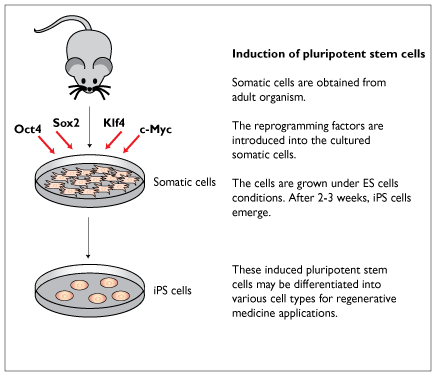
Human cloning has raised several ethic and legal issues. However, the ultimate intention of science is to benefit the entire human population. Konrad Hochedlinger's article on the new findings of iPSCs provides a new great leap in the stem cell research. From scientists' newest discoveries, mature body cells can be reprogrammed into induced pluripotent stem cells to cure many diseases in the future. As we know, some cells in our bodies only divide once and always stuck at G1 phase of the cell cycle. If such cells are destroyed, we can no longer reproduce them. However, if iPSCs are proved to be function in human bodies well in the future, these cells can be reproduced.

As this picture below shows, the cells can be reprogrammed through reprogramming factor genes and become iPSCs.


Sunday, January 5, 2014

Mitosis and Meiosis

There are two types of cell divisions, mitosis and meiosis.

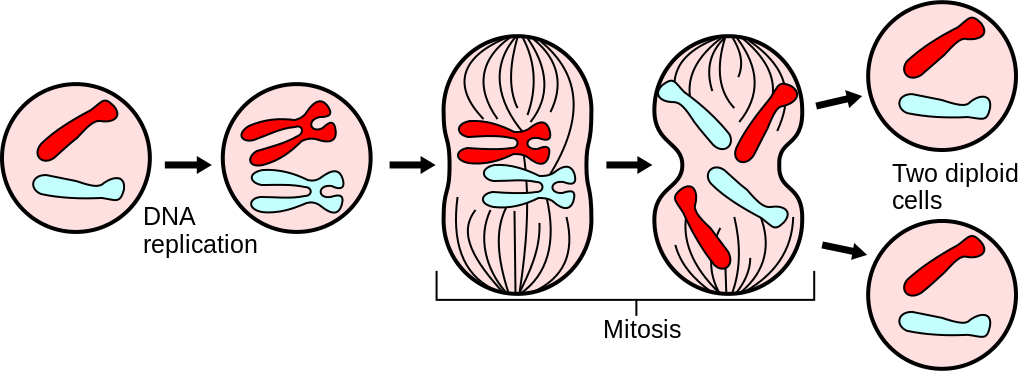
Mitosis is a process in which two exactly the same cells are reproduced from one.
Meiosis involves two cell divisions that give rise to four gametes (sex cells), each possessing half the number of chromosomes in the original cell.

Mitosis and meiosis are similar in some stages.


Interphase: Interphase (G1 and G2)
Chromosomes are not easily visible because they are uncoiled.

Prophase:
The chromosomes begin to coil.
The spindle apparatus begins to form as centrosomes move apart.

Prometaphase:
The nuclear membrane disintegrates.
Kinetochores form on the chromosomes.
Kinetochore microtubules attach to the chromosomes.

Metaphase:
The chromosomes become aligned on a plane.

Anaphase:
The chromatids separate (The number of chromosomes doubles).

Telophase:
The nuclear membrane reappears.
The chromosomes uncoil.
The spindle apparatus breaks down.
The cell divides into two.

Meiosis

Prophase I
Homologous chromosomes become paired.
Crossing-over occurs between homologous chromosomes.

Metaphase I
Homologous pairs become aligned in the center of the cell.

Anaphase I
Homologous chromosomes separate.

Telophase I
This stage is absent in some species


The second cycle in Meiosis includes the same stages for the first cycle except that they take place in cells with half the chromosomes.
Monday, December 9, 2013

Special Genetics

Incomplete Dominance: When one homozygous dominant parent crosses with a homozygous recessive parent, the offspring would be only one type—heterozygous. However, sometimes heterozygous offspring has different trait with the dominant parent. For example, some heterozygous flowers have pink color when their parents have red and yellow flowers.


Multiple Alleles: In different blood types, there are three types of alleles--I^a, I^b, and i. The first two alleles are both dominant, and the last one is recessive. Blood type A can be produced by two I^a or one I^a and i. Similarly, blood type B can be formed by two I^b or one I^b and i. Blood type O can only formed by two recessive alleles. And Blood type AB can be formed by one I^a and one I^b.


Sex-linked Genes: Genes that locate on a sex chromosome are sex-linked genes. X chromosome carries more genes than Y chromosome. Males only have one allele for most X-linked genes. Females have two alleles for X-linked genes. In a Punnett square, when a male is crossed with a female, 50% of the offspring would be a boy because there are two alleles that have Y chromosome. Diseases such as hemophilia and color blindness can be passed on through sex-linked crosses.

Dihybrid Cross

The difference between a dihybrid cross and a monohybrid cross is that a dihybrid cross involves two types of alleles at the same time.

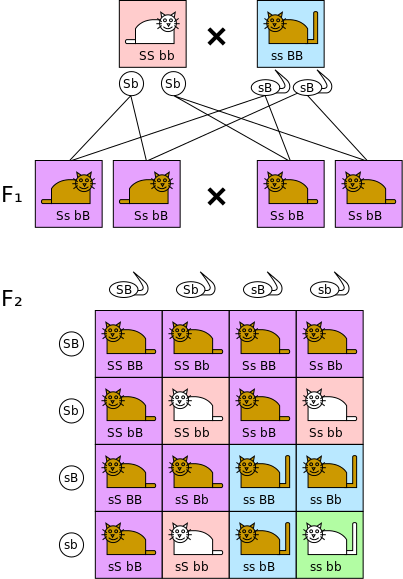
Usually, we can figure out the offspring of a dihybrid cross in two ways. The first way is to take one allele from each trait at a time from a single parent and combine every two to form a gamete. List the male gametes on one row of the Punnett square and female gametes on the column of the Punnett square. We can have 16 genotypes from the cross and then conclude the genotypic and phenotypic ratios.


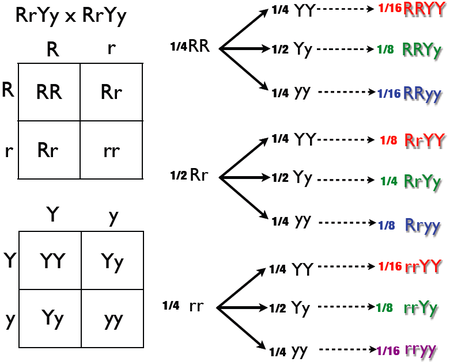
The second way is to create two Punnett squares by separating the two traits. Put one allele at a time from each parent on the sides of the square. If there were two traits such as black/brown hair and brown/blue eyes, the first Punnett square can be allele combinations for hair color and the second square for eye color. Then, we can determine the genotypic and phenotypic ratios of offspring by combining the traits of two squares.